 how-to
How to Insure a Home Business With Specialized Equipment
Table of Contents
- Why Your Homeowners Policy Likely Won't Cover Business Equipment
- Step 1: Build a Detailed Inventory of Your Specialized Equipment
- Step 2: Value Each Item and Choose Replacement Cost or Actual Cash Value
- Step 3: Add a Home Business Insurance Coverage Endorsement or Separate Policy
- Step 4: Cover Equipment Breakdown, Off-Site Use and Leased or Borrowed Gear
- Step 5: Estimate Your Home-Based Business Insurance Cost and Compare Trade-Offs
- Booking Your Coverage Review With Bringas Insurance
- Frequently Asked Questions
Why Your Homeowners Policy Likely Won't Cover Business Equipment
Last Updated: November 5, 2026
If you run a business from your home, your standard homeowners policy probably won't cover the tools and equipment you use to earn money, which is why learning how to insure a home business with specialized equipment matters before a loss happens. Understanding this gap before something goes wrong helps you protect your equipment. (Source: the National Association of Insurance Commissioners (NAIC))
Most homeowners policies cover personal property, not business property. Coverage for business equipment is often limited to a small sub-limit, and only for certain types of loss. Check your declarations page for the exact amount.
Standard policies also often exclude claims tied to business activity, such as liability from client visits. A homeowners policy typically won't respond if a client slips on your front steps during a session.
- Business equipment usually has a low sub-limit under a homeowners policy
- Specialized or high-value gear can exceed that limit quickly
- Liability from business activity is often excluded entirely
Step 1: Build a Detailed Inventory of Your Specialized Equipment
A clear inventory is the foundation of good coverage. Without one, you can't know how much you need or prove what you lost.
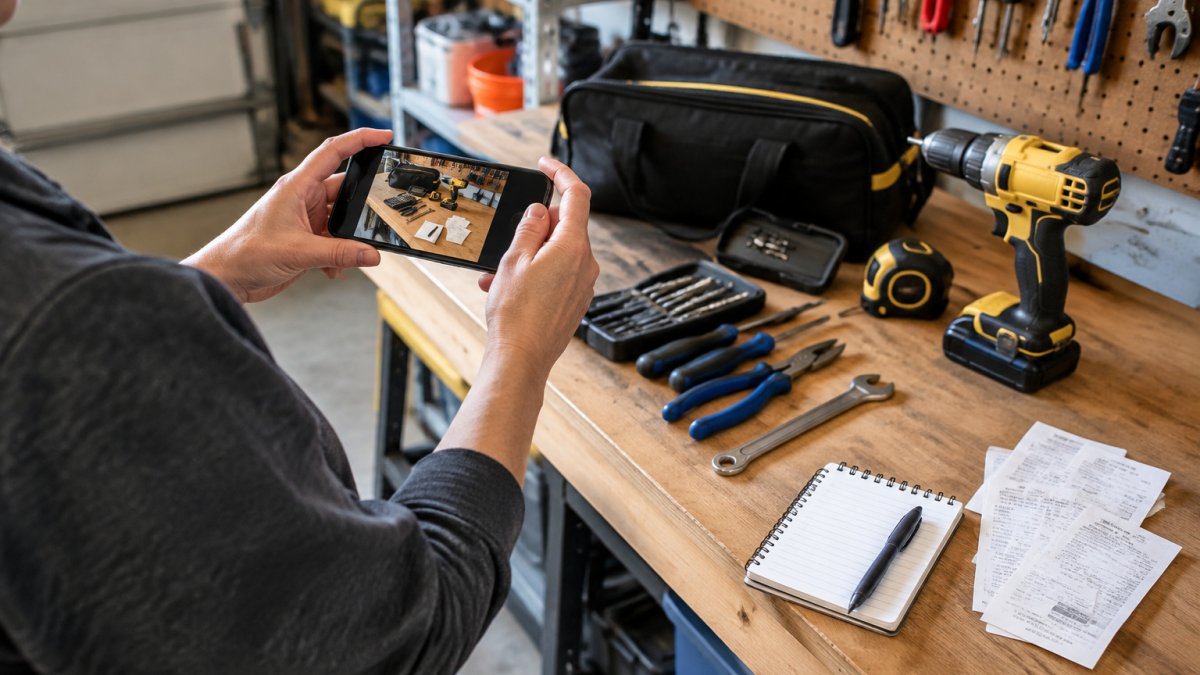
Start by listing every piece of equipment you use to run your business. Include make, model, serial number, purchase date, and purchase price. Photos and receipts help a lot.
Here is a simple way to organize your list:
- Item name and description: For example, "commercial laser engraver"
- Serial number: Found on the device or in its manual
- Purchase date and price: Keep receipts or bank records
- Current condition: Note any wear or damage
- Location: Where it's kept at home or elsewhere
Walk through each room you use for work. Check closets, garages, and storage areas. Many business owners forget smaller items like accessories or spare parts, which add up.
Update your inventory whenever you buy or sell gear. A list from two years ago may leave out major purchases.
Document serial numbers so a claim can be matched to the right item
Serial numbers are the single most useful field on the list. They let an insurer confirm that the item you are claiming is the item that was insured, and they help law enforcement identify recovered equipment after a theft. Record the number exactly as it appears on the manufacturer's label, not from memory. Photograph the label itself, because labels fade, peel, or are removed during repair. For equipment without a serial number, such as custom-built fixtures or shop-made jigs, assign your own internal asset tag and note it on the list.
Keep receipts and proof of ownership in more than one place
A receipt establishes both the purchase date and the price you paid, which matters when an insurer applies depreciation or compares your claimed value to market pricing. Keep digital copies in cloud storage and a paper copy somewhere outside the workspace, because a fire or flood that destroys the equipment will also destroy a folder stored next to it. Bank and credit card statements can substitute when a receipt is missing, and for used equipment a bill of sale or marketplace listing screenshot is better than nothing.
Record condition and replacement cost, not just purchase price
Purchase price tells an insurer what you paid; replacement cost tells it what it would take to put you back in business today. Those numbers can diverge sharply for equipment bought years ago, for gear affected by tariffs or supply shortages, and for items you acquired used. For each item, note its current condition (new, good, fair, parts-only) and a current replacement estimate from a vendor quote, a recent retail listing, or a manufacturer's price sheet. Condition notes also protect you: if an item was already worn or partially nonfunctional before a loss, documenting that upfront prevents a dispute later over pre-existing damage.
Set limits from the inventory, not from the policy label
Once the list is complete, total the replacement values by category (for example, production equipment, computers and cameras, hand tools, and accessories). Compare those subtotals to the per-item and aggregate limits on your policy. A common pattern is that the aggregate limit looks adequate until one high-value item consumes most of it, leaving the rest of the shop underinsured.
Watch out: an inventory that lists only purchase prices can understate what you need to replace specialized gear today, and an inventory with no serial numbers or photos can stall a claim even when the loss is clearly covered.
Step 2: Value Each Item and Choose Replacement Cost or Actual Cash Value
Once you have your list, you need to put a dollar value on each item. Insurers usually settle claims on one of two bases.
- Replacement cost: Pays what it costs to buy a new item of similar kind and quality, with no deduction for age.
- Actual cash value: Pays replacement cost minus depreciation for age and wear. This payout is usually lower.
Replacement cost typically costs more in premium, but it leaves you closer to whole after a loss. Actual cash value is cheaper but can leave a large gap on newer, expensive equipment.
For each item, ask yourself how much it would cost to replace today. Then compare that figure to the limit on your policy.
Some business owners pick replacement cost for their primary equipment and accept actual cash value for older or less critical items.
Step 3: Add a Home Business Insurance Coverage Endorsement or Separate Policy
You have two main ways to close the gap. Each one fits different situations.
Home business endorsement: This is an add-on to your homeowners policy. It typically raises your business property limit and can add some liability protection.
Separate business policy: A standalone policy, such as a business owners policy (BOP), covers property, liability, and sometimes business interruption in one package. It suits businesses with higher risk, employees, or significant client contact.
Ask your agent these questions when comparing options:
- How high is the business property limit?
- Does the policy cover equipment that leaves the home?
- Is liability coverage included, and at what amount?
- Is business income loss covered if equipment is damaged?
Be careful with endorsements that look broad but carry low limits. An endorsement that covers $5,000 may not protect a $40,000 equipment setup.
Step 4: Cover Equipment Breakdown, Off-Site Use and Leased or Borrowed Gear
Many home-based businesses take equipment to job sites, events, or client locations. Standard property coverage often stops at your front door, so check off-site protection carefully.
Ask whether your coverage applies to equipment:
- Used away from home: Transit and off-premises coverage may be needed
- Damaged by mechanical breakdown: Equipment breakdown coverage addresses failures not caused by a covered peril like fire
- Leased or financed: The lender or lessor may require specific coverage
- Borrowed from others: You may be responsible for damage to gear you don't own
Watch out: Leased or rented equipment is often not your property. Without the right coverage, you could owe the full replacement cost to the owner after a loss.
Confirm the rules for each category with your insurer. Coverage for off-site and breakdown losses varies by policy and by state.
How coverage behaves while equipment is in transit and at a client site
Off-premises coverage is usually defined by two things: how far from the insured location the property is, and whether it is in your care, custody, or control at the time of loss. A policy may extend business personal property coverage to equipment temporarily away from home, but often at a lower sub-limit than the on-premises limit, and sometimes only within a defined radius or for a defined time period. Equipment left overnight in a vehicle, stored in a client's garage, or shipped by common carrier may fall outside that extension entirely.
Common loss scenarios and how they are typically treated
Coverage depends on policy wording, but the pattern across most commercial forms is consistent enough to plan around. Theft from a locked vehicle or job site is often covered under business personal property, but many policies impose a lower theft sub-limit for property in vehicles and require evidence of forced entry. Accidental damage such as a dropped camera or a cracked screen is generally covered if the peril is not excluded, though some policies exclude damage caused by faulty workmanship or by the equipment's own operation.
Leased, financed, and borrowed equipment: who insures what
When equipment is leased or financed, the lease or loan agreement usually names the lessor or lender as a loss payee and requires you to carry property coverage at least equal to the equipment's value. If you fail to maintain that coverage, the agreement may allow the lessor to buy coverage and bill you, often at a higher rate. Borrowed equipment is the reverse problem: the owner's policy may not cover it while it is in your possession, and your policy may treat property of others differently from property you own, sometimes with a lower limit.
Build a location and ownership checklist before you buy coverage
List each piece of equipment by where it travels and who owns it: stays home and owned, travels to client sites and owned, leased or financed, and borrowed or rented. For each row, note the maximum value on site at any one time and the longest period it is away from home. That checklist is what an agent needs to compare an off-premises sub-limit against a scheduled equipment endorsement, and it is also what an adjuster will ask for after a loss.
Step 5: Estimate Your Home-Based Business Insurance Cost and Compare Trade-Offs
Costs depend on your equipment value, your business type, and the limits you select. Pricing depends on your details and the limits you select. Visit the Bringas Insurance website or request a quote for current pricing.
Focus on the trade-offs. Higher limits and replacement cost coverage raise premiums but reduce your financial risk. A lower deductible means paying more upfront on each claim but less out of pocket when a loss occurs.
Use this quick comparison to weigh your options:
| Option | Premium impact | Protection level | Best for |
|---|---|---|---|
| Homeowners policy only | Lowest | Very limited for business gear | Hobby use with little equipment |
| Home business endorsement | Low to moderate | Moderate for property | Small operations with modest gear |
| Separate business policy | Moderate to higher | Broad, including liability | Businesses with clients, staff, or valuable equipment |
Get at least two quotes so you can compare coverage terms, not just price. For a clear estimate based on your actual equipment and business, request a free quote from Bringas Insurance.
Booking Your Coverage Review With Bringas Insurance
Once you have your inventory and valuation in hand, a coverage review can show you where your gaps are. Bringas Insurance can walk through your equipment, limits, and options with you. To schedule your review, contact Bringas Insurance.
Frequently Asked Questions
Can I insure a piece of equipment for business?
Yes. Equipment used for a business can be insured, but the policy has to be written for business use. A standard personal policy often excludes or limits business property, so you may need a business personal property endorsement, an equipment floater, or a business owners policy. Start by listing each item with its make, model, serial number, purchase date and purchase price. Your insurer will use that list to set coverage limits and to decide whether each item needs to be scheduled separately. Ask the insurer how it values items, whether it pays replacement cost or actual cash value, and whether coverage applies when the equipment is used away from home.
Does homeowners insurance cover business equipment?
Usually only in part. Most homeowners policies include a limited amount of coverage for business property kept at home, and many exclude business equipment entirely or cap payouts at a low sub-limit. Coverage may also be denied if the business activity is not disclosed. Review your declarations page and ask your agent whether business personal property is covered, what the sub-limit is, and whether an endorsement can increase it. Equipment used away from the home, such as on job sites, is often not covered by a homeowners policy at all.
How much does home-based business insurance cost?
Cost depends on the type and value of the equipment, the coverage limits you choose, your deductible, the kind of work you do, and whether clients visit your home. Bringas Insurance does not publish standard prices for these policies. For current figures based on your situation, request a quote from Bringas Insurance through the website, and compare the premium against the coverage limits, deductible and exclusions in each proposal rather than the premium alone.