 comparison
Who Is the Most Trusted Car Insurance in 2026?
Last Updated: October 29, 2026
Quick Summary
The most trusted car insurance is the company that pays claims fairly and stays financially solvent, judged by financial ratings, complaint ratios, claims handling and customer service together rather than price alone. Travelers and Progressive are named as top-rated overall in 2026 comparisons, but a company ranking well nationally can still rank poorly in your state.
- Check the financial strength rating of the specific company underwriting your policy, since many brands are subsidiaries.
- Use the NAIC Consumer Information Source to compare complaint ratios, not raw complaint counts.
- Ask each insurer in writing how it values totaled vehicles and how long total-loss claims take.
- Compare at least three quotes using identical coverage limits and deductibles.
- Verify state-specific complaint data before treating a national ranking as a recommendation.
Table of Contents
- What Makes a Car Insurance Company Trustworthy
- Top-Rated Car Insurance Companies in 2026
- Best Car Insurance Companies for Customer Service
- Car Insurance Company Claims Satisfaction: What to Check
- How to Compare Car Insurance Quotes Fairly
- Questions to Ask Before Buying Car Insurance
- Booking Your Free Quote With Bringas Insurance
- Frequently Asked Questions
What Makes a Car Insurance Company Trustworthy
Trust in a car insurer comes down to whether it pays claims fairly and stays solvent when it matters. A thorough review looks at financial strength, complaint records, claims handling and customer service together rather than relying on a single ranking. The most trusted car insurance is rarely the cheapest one, and it is rarely the largest one either, because trusted car insurance is measured by how well a company performs across all of these areas.
Many drivers assume a low premium signals a good insurer. Often it signals only that the company is pricing aggressively. We recommend checking how a company handles the moment you need it most, not just what it charges on day one.
Financial Strength and Ability to Pay Claims
A trustworthy insurer must be able to pay claims in full, even after a major storm or a spike in accidents. Ratings from independent agencies such as AM Best and S&P Global are a practical place to start. Check the rating of the specific insurance company underwriting your policy, since many brands are subsidiaries of a larger group.
Company size is not a guarantee of stability. Smaller carriers can be solid, and large ones can struggle in a bad year. Look at the rating and the company's recent financial reports before deciding.
Complaint and Regulatory Data
Complaint records show how a company behaves when claims go wrong. The National Association of Insurance Commissioners publishes complaint data through its Consumer Information Source, which lets you compare insurers side by side. Your state insurance department also tracks complaints and can tell you how many were filed against a specific company.
A low complaint count matters, but read the details. A high volume of complaints may simply reflect a large customer base, so compare complaints against the company's market share.
Top-Rated Car Insurance Companies in 2026
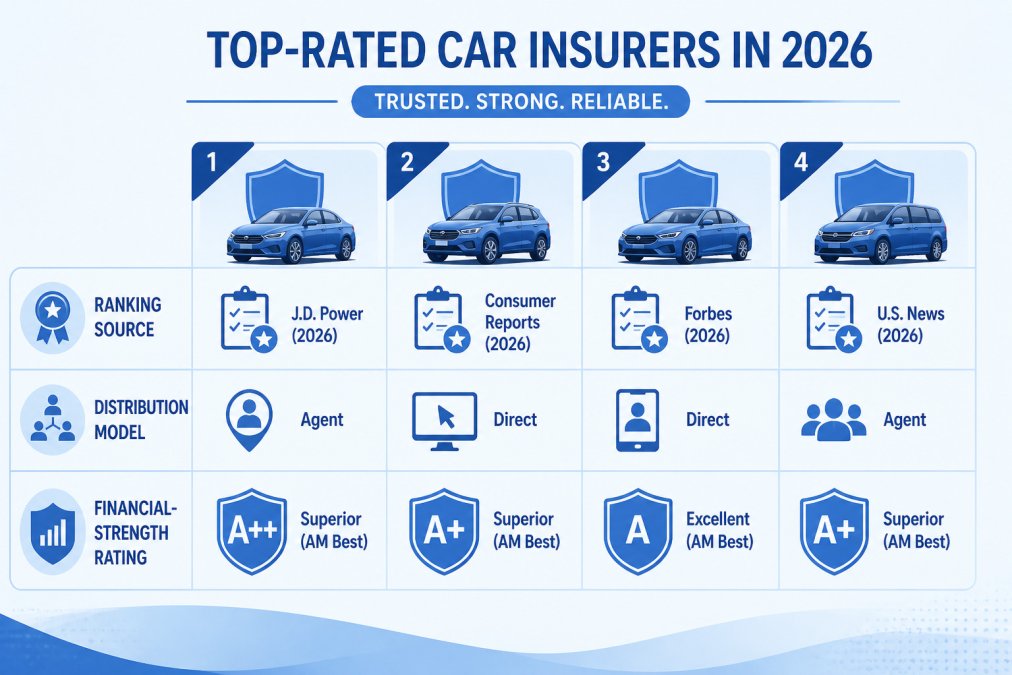
Rankings are a starting point, not a verdict. The companies below appear repeatedly across independent 2026 comparisons, but each earns its place for a different reason. Use this section to understand why a company shows up on lists, then verify the details that matter for your household.
Travelers was named best overall by U.S. News and best for price by Forbes Advisor in their 2026 comparisons. That dual recognition is unusual and worth noting: it suggests strength in both editorial quality scoring and rate competitiveness. Travelers is a large, long-established carrier with a broad independent-agent distribution network, which matters if you prefer working with a local agent rather than a call center. The sources reviewed did not include Travelers-specific premiums, so request a quote before assuming it is affordable for your profile.
Progressive was named the best car insurance company in a 2026 Wall Street Journal analysis and appears among top-rated companies in U.S. News. Progressive is also one of the few major carriers that publishes a direct comparison tool letting you see its quote alongside rates from other companies, a useful transparency feature when you are shopping. Progressive's model leans heavily on online and phone sales, with a smaller independent-agent footprint than Travelers or Amica.
GEICO appears among top-rated companies in U.S. News' 2026 comparison and is listed by Insurify and The Zebra. GEICO appears among top-rated companies in U.S. News' 2026 comparison. Check its current prices and claims service directly.
Amica is included in NerdWallet's 2026 national car insurance comparison and has a long-standing reputation for customer service among mutual insurers. Amica is a mutual company, meaning policyholders are members rather than shareholders, a structural difference that some drivers weigh when thinking about long-term alignment. Rates and customer-service findings were not part of the sources reviewed, so verify those directly.
State Farm and Allstate appear in many national comparisons, though their rankings vary by source and by state.
Start with the insurers that rank well across several independent lists, then compare at least three real quotes using identical coverage limits and deductibles. Bringas Insurance can help you compare options across carriers in one conversation.
NAIC Consumer Information Source
Best Car Insurance Companies for Customer Service
Customer service shows up when you call after a fender bender at 11 p.m. Ask how quickly you can reach a representative, whether agents can explain your coverage in plain language, and whether you can file a claim online or by phone.
For Spanish-speaking households, language access matters. Ask each company directly whether it offers service in Spanish before you buy.
Car Insurance Company Claims Satisfaction: What to Check
Claims are where trust is tested, and most rankings do not show you what happens after a crash. The gap between a company's marketing and its claims behavior is where drivers get hurt. This section gives you a practical way to evaluate claims handling before you buy, a step most comparison articles skip.
The three claims metrics that actually matter
1. Complaint ratio, not raw complaint count. The National Association of Insurance Commissioners publishes complaint data through its Consumer Information Source, and state insurance departments publish their own complaint indexes. The useful number is the ratio of complaints to premiums written or policies in force, not the raw count, since larger carriers will always have more total complaints than smaller ones.
2. Claim denial and dispute patterns. Ask your agent, in writing, how the company handles disputed claims and what the appeal path looks like. Many state insurance departments publish complaint reports broken down by reason. Review the categories in your state's report to see where a company's complaints concentrate.
3. Settlement speed and total-loss handling. Total-loss claims are often where satisfaction breaks down, because the payout depends on valuation methodology. Ask whether the company uses an independent valuation service, whether it covers sales tax and registration fees on a total loss, and how long total-loss claims take from first notice of loss to payment. Answers vary by carrier and by state.
How to read the data without being misled
Complaint data has real limitations. Complaint volume is influenced by company size, by the states where it writes, and by how easy the company makes it to file a complaint. A company that hides its complaint hotline will look better in the data than one that publicizes it. Treat complaint ratios as one input, not a verdict.
Questions that reveal how a company really handles claims
Ask these before you buy, and ask for answers in writing:
- What is your average time from first notice of loss to first contact with an adjuster?
- Do you use staff adjusters, independent adjusters, or both?
- How do you value a totaled vehicle, and can I see the valuation report?
- What is the appeal process if I disagree with a settlement, and how long does it take?
- Can I track my claim online, and can I reach a human adjuster by phone?
A transparent insurer will answer these without hesitation. An evasive answer is itself information.
Where to find independent claims data
- Your state insurance department's annual complaint report, which typically ranks companies by complaint index.
- The NAIC's Consumer Information Source, which lets you compare complaint ratios across companies.
State insurance department complaint reports
Claims handling is where trust is tested, so the article points to three metrics worth checking before you buy.
| Metric | What to check | Where to find it |
|---|---|---|
| Complaint ratio | Complaints relative to policies in force, not raw count | NAIC Consumer Information Source |
| Claim denial and disputes | Appeal path and complaint categories | State insurance department reports |
| Total-loss handling | Valuation method and time to payment | Ask the insurer in writing |
| Settlement speed | Time from first notice of loss to payment | Ask the insurer in writing |
How to Compare Car Insurance Quotes Fairly
Comparing quotes only works when each quote covers the same things. Use the same coverage limits, the same deductibles and the same driver information for every quote you request. Otherwise the cheapest number may simply reflect less protection.
Start with the minimum coverage required in your state, then compare what each insurer offers above that minimum. Include liability limits, collision and comprehensive coverage, and uninsured motorist protection. Write the results side by side so you can see exactly what each premium buys.
Think about total value, not only the premium. A slightly higher price from a financially strong insurer with fast claims service may be the better buy.
Questions to Ask Before Buying Car Insurance
Before you sign, ask a few direct questions:
- How financially stable is the company underwriting this policy?
- What are my liability limits, and are they enough to protect my savings?
- What is my deductible for collision and comprehensive claims?
- How do I file a claim, and what is the typical timeline?
- Are discounts available for bundling, safe driving or vehicle safety features?
- Is service available in Spanish?
Many drivers skip these questions and regret it later. Our article on local insurance agents versus online buying explains the benefits of working with a local agent versus going online. An agent who answers them clearly is usually an agent worth keeping.
Booking Your Free Quote With Bringas Insurance
If you want to compare trusted options for your auto coverage, request a free quote from Bringas Insurance and we will walk through your coverage needs in plain language. You can also start your quote request online when you are ready to act.
We offer auto, home, life and business insurance. Request a free quote to get started.
Frequently Asked Questions
Which car insurance company is the most trusted?
No single insurer is the most trusted for every driver. Trust depends on how a company handles claims, how many complaints it draws relative to its size, and its financial strength. Independent 2026 rankings from U.S. News, Forbes Advisor and NerdWallet place Travelers, GEICO, Progressive and Amica among the top-rated options, but those rankings do not measure every factor. Check each insurer's state complaint data and financial strength rating, then compare quotes for your own driver profile and location.
Which car insurance companies have the best customer service?
Customer service ratings vary by company and by state, so look at recent satisfaction surveys and complaint records rather than a single overall score. Check how easily you can reach a person by phone, whether claims can be started online, and whether the company offers service in the language you prefer.
How can I tell if an insurer will pay my claim?
Look at claim settlement practices, reported complaint volume, and financial strength ratings from independent rating agencies. Ask the insurer how it handles claim denials and how long settlements typically take. Read the policy's exclusions and coverage limits before you buy so you know what is covered in advance.
What should I ask before buying car insurance?
Ask what coverage limits and deductibles you need, which discounts you qualify for, how claims are filed and handled, and whether you can speak with a person in your preferred language. Confirm the total premium including fees, how renewals are priced, and what happens if you switch policies mid-term. Getting clear answers to these questions before signing makes it easier to compare quotes on equal terms.